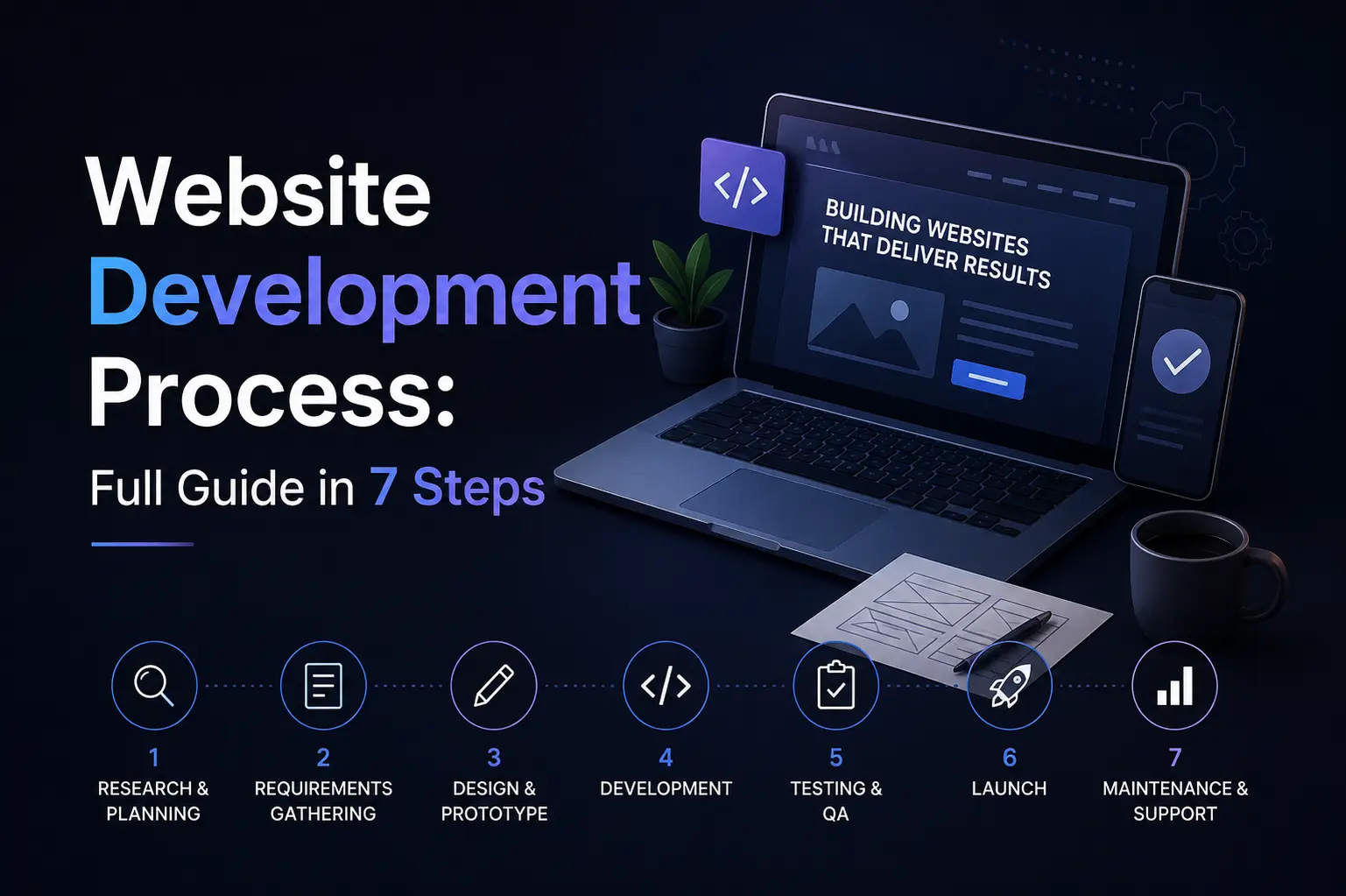
A successful website requires more than attractive visuals and clean code. It involves research, planning, design, development, testing, launch, and continuous improvement.
5 Key Takeaways
- Define business goals, audience, features, scope, and measurable objectives before development begins.
- Plan the sitemap, wireframes, content, technology, SEO, and project timeline carefully.
- Combine attractive design with usability, accessibility, mobile responsiveness, and clear navigation.
- Test functionality, performance, security, content, forms, links, and responsiveness before launch.
- Continue improving websites through analytics, maintenance, updates, feedback, and optimization.
A structured website development process helps businesses reduce errors, control costs, improve user experience, and build a website aligned with their goals.
Whether you are creating a business website, ecommerce store, portfolio, or custom web application, understanding each stage helps you make better decisions and work more effectively with developers.
Why Is a Structured Website Development Process Important?
The website development process provides a clear roadmap from an initial idea to a functioning website. Without proper planning, businesses may experience scope creep, repeated design changes, technical problems, and unnecessary development costs.
A structured approach connects business requirements with user expectations and technical needs. It also gives stakeholders clear opportunities to review progress before moving to the next stage.
Step 1: Define Goals, Audience, and Requirements
The first stage is discovery. Before choosing a platform or designing pages, determine what the website should achieve and who it should serve.
Consider:
- What is the website's main purpose?
- Who are the target users?
- What actions should visitors take?
- Which pages and features are required?
- What business problems should the website solve?
Requirements should include functionality such as forms, ecommerce, bookings, accounts, payments, or integrations. Technical requirements should address performance, security, accessibility, scalability, and reliability.
Clear requirements create a strong foundation for the rest of the website development process.
Step 2: Plan the Sitemap, Wireframes, and Technology
Once requirements are established, plan the website structure.
A sitemap defines how pages are organized and connected. It helps create logical navigation and ensures important information is easy to find.
Wireframes then provide basic layouts for pages, showing where navigation, headings, images, forms, and calls to action will appear.
The technical plan should identify the CMS, programming languages, frameworks, database, hosting, APIs, and other integrations required.
Planning these elements early makes the website development process more efficient and reduces major changes during development.
Step 3: Create the Visual Design and User Experience
This stage transforms basic wireframes into a polished interface. Website development and design should work together to create an experience that is attractive, intuitive, and easy to navigate.
Designers establish typography, colors, imagery, spacing, buttons, layouts, and interaction patterns while maintaining brand consistency.
Responsive design is essential because visitors use different devices and screen sizes. Accessibility should also be considered through readable text, appropriate contrast, keyboard navigation, meaningful labels, and alternative text.
Getting design approval before extensive coding can significantly reduce revisions later.
Step 4: Prepare and Optimize Content
Content is an essential part of website development and design because it influences user understanding, conversions, and search visibility.
Prepare:
- Page copy and headings
- Product or service descriptions
- Images and videos
- FAQs
- Calls to action
- Meta titles and descriptions
SEO should be considered during content preparation. Clear headings, descriptive URLs, internal links, optimized images, mobile-friendly content, and appropriate structured data can help search engines understand the website.
Content should answer users' questions naturally rather than simply targeting keywords.
Step 5: Develop the Website
After design and content approval, developers begin implementation. Front-end development creates the interface users interact with, while back-end development manages databases, APIs, authentication, server-side processes, and complex functionality when needed.
Custom website development is useful when a business needs features that standard templates cannot efficiently provide. These might include customer portals, booking systems, dashboards, calculators, ecommerce workflows, or specialized integrations.
Development should consider security, scalability, performance, accessibility, and SEO from the beginning.
Using staging environments and version control also allows developers to test changes safely before publishing them.
Step 6: Test and Launch
Testing is one of the most important stages before a website goes live. Every major function should be checked across browsers, devices, and screen sizes.
Important checks include:
- Links, buttons, and navigation
- Forms and notifications
- Mobile responsiveness
- Page speed
- Browser compatibility
- Security
- Metadata and redirects
- Analytics tracking
- Content accuracy
- Accessibility
A staging website allows teams to identify and fix issues without affecting the live site.
After final approval, the website can be launched. Teams should continue monitoring the site immediately afterward to ensure important pages, forms, tracking, and redirects are working correctly.
Step 7: Maintain, Measure, and Improve
The website development process does not end when the website goes live. Websites require ongoing maintenance because technologies change, security vulnerabilities emerge, content becomes outdated, and customer expectations evolve.
Ongoing activities may include:
- Software and dependency updates
- Security monitoring
- Backups
- Performance optimization
- Content updates
- Broken-link checks
- Technical SEO reviews
Google Analytics can reveal which pages attract visitors, where users leave, and which actions generate conversions. This information can guide improvements to content, navigation, calls to action, speed, and functionality.
For businesses that need continuous technical support, professional web development services can help with maintenance, upgrades, integrations, and new features.
How Long Does Website Development Take?
There is no fixed timeline for every website. A simple business website may take a few weeks, while an ecommerce platform or complex custom application can take several months.
The timeline depends on the number of pages, design complexity, functionality, content readiness, integrations, approval cycles, and development resources.
Rather than focusing only on a launch date, businesses should establish milestones for discovery, planning, design, development, testing, and deployment.
Common Website Development Mistakes to Avoid
Several mistakes can affect website performance and usability. Starting without clear requirements can cause scope creep. Ignoring mobile users can create poor experiences. Treating SEO as an afterthought can lead to technical problems that are harder to correct later.
Other common mistakes include:
- Launching without comprehensive testing
- Ignoring accessibility
- Using unnecessary plugins
- Neglecting security updates
- Creating content too late
- Choosing technology without considering long-term requirements
A thoughtful process helps prevent these problems and creates a stronger foundation for future growth.
Why Choose Aarav Tech Solutions for Web Development?
Choosing an experienced partner can make the website development process more organized and efficient. Aarav Tech Solutions provides website development services focused on creating responsive, user-friendly, and business-oriented websites.
The team can support planning, UI/UX, development, integrations, responsive implementation, and ongoing improvements. Businesses with specific technical requirements can also benefit from custom website development instead of relying entirely on standard templates.
With a focus on usability, performance, mobile responsiveness, SEO-ready implementation, and scalable technology, Aarav Tech Solutions helps businesses build digital experiences designed around their goals. Its professional web development services can also provide businesses with technical expertise without requiring a large in-house development team.
Conclusion
A website is most successful when every stage is planned and connected. From defining requirements and creating the sitemap to designing, developing, testing, launching, and maintaining the site, each step contributes to the final experience.
Following a structured website development process helps businesses avoid common mistakes while creating websites that are functional, accessible, SEO-friendly, and prepared for future growth.